

Publication Intelligence articles
Why a Reviewable AI Book Index Takes Time
Plan for automated processing and human review: why whole-book coherence and source-linked locators take work, and what affects an AI indexing run.
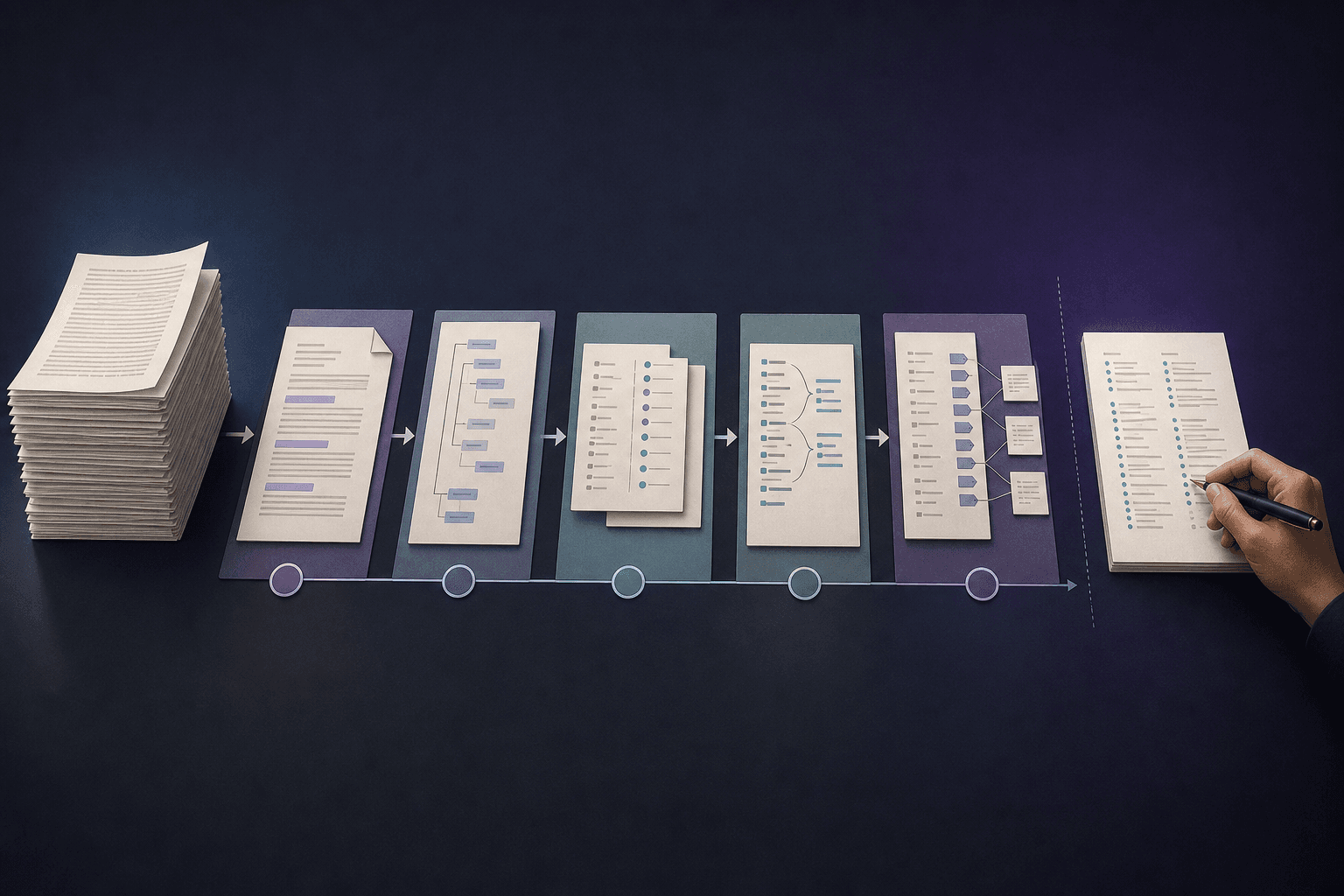
Your final proofs are ready, and the index is on the production schedule. If AI can generate a list of subjects quickly, why does a reviewable book index take longer? The answer matters when you are deciding when to start processing and how much time to reserve for review.
A useful subject index has to connect discussions across a whole book and send readers to passages that support each entry. Publication Intelligence performs automated work toward that goal before handing the draft to a reviewer. Processing time and human labor are separate parts of the schedule; neither tells you, by itself, whether the index is ready.
Plan for two kinds of time
Elapsed processing time is the time a run spends preparing and analyzing the book, checking proposals, and assembling results. Those operations can run in the background while you do other work. They do not require someone to watch each page or remain at the keyboard.
Human labor includes resolving preparation questions and reviewing the resulting index. A run can pause for a source decision, such as an uncertain printed page label. Waiting for that decision adds to the calendar without representing continuous automated processing. Later, editorial review needs its own place in the production schedule.
This distinction makes a processing estimate useful without making it a promise about your workload. A draft arriving sooner does not establish that it will need less revision. A longer run does not establish that it is better.
A book needs one coherent access system
Consider an original illustrative book about urban water policy. An early chapter discusses rainwater harvesting; a later chapter uses rainwater collection for the same practice. Another discusses collecting water-quality samples, which is a different subject. Simply combining chapter lists could scatter one discussion under two headings and merge another by mistake.
The index needs a consistent heading for the first concept, an alternative route where useful, and a distinct entry for water-quality sampling. That decision depends on the discussions and the reader’s likely vocabulary. It also affects subheadings and cross-references elsewhere in the index.
Publication Intelligence develops candidates from parts of the book, then reconciles and checks the assembled index. Some questions need another look at the source. This comparison work explains part of the elapsed time: a locally plausible entry must also fit the publication as a whole. Automated checks can expose conflicts, but an editor or indexer still decides whether the final organization serves the audience.
Review needs passages, not just page numbers
In the same invented book, suppose page 18 lists rainwater harvesting among several measures, page 76 explains how household systems work, and page 142 compares subsidy schemes. A candidate entry for rainwater harvesting—household subsidies should not inherit every page associated with the broader subject. The full heading must fit the passage it points to.
Testing that fit involves more than finding matching words. The software assesses the proposed heading against source text and retains supporting evidence with accepted locators. A reviewer can then inspect the passage and decide whether the entry accurately describes it. The passage is a reason to examine a proposal, not proof that the editorial decision is infallible.
The subject-index workflow and page-by-page verification workflow explain how those proposals reach review. Source-linked evidence makes checking possible; it does not establish that every important subject has been found.
What changes the elapsed time?
- The amount and structure of the source: more text and more candidate entries create more work to compare and check. Irregular reading order or pagination can also require preparation decisions.
- The work still needed: ambiguous heading scope, source checks, and recovery from unsuccessful requests can add processing. Some work can run concurrently; whole-book decisions depend on earlier results.
- The selected index: subject, author, and Scripture indexes ask different questions and use different workflows. Their processing times are not interchangeable.
The subject progress view can show an estimate of remaining automated work. Treat it as planning information that may change as the run develops. It does not include the time you will spend checking audience fit, missing access points, terminology, or house style. No universal duration or hours-saved claim follows from it.
Make the handoff part of the schedule
Before starting, agree who will review the draft and who can approve it for publication. Then keep these boundaries visible:
- Confirm the source revision, printed page labels, and indexable scope before generation.
- Check whether a run is processing, awaiting a decision, or ready for review; do not treat every wait as machine work.
- Reserve human time to check the whole index as well as its individual locators.
- Approve the revised index against the title’s requirements before treating it as finished.